The first attempt I made to walking in the hospital was just a few days after being admitted in the hospital. This video was recorded June 29, 2021 – 5 days post stroke. It’s extremely hard for me to watch back. I actually remember some of the details of this day. The inpatient therapists from the 6th floor of the hospital came to visit me. It was the first time I recognized I truly needed assistance with putting on my clothes. I guess I had been too drugged up previously to recognize the severity of my condition. I recall my desire to move my left arm through my sleeve but nothing happened. My left arm did not budge. There was zero movement from my shoulder down. It just hung there on my body like a foreign part. I did have feeling and sensation in my left arm. It just felt super heavy. I’m not a huge fitness buff but I was conditioned enough to be able to put out a few reps of 15lbs bicep curl. In my current condition, I felt it weighed a ton and moving it was near impossible. With some assistance from the nurses, I was able to change from my lovely hospital gown with the back side flapping open to a button up pajama top and slip on some bottoms.
Taking my 1st steps
As for my lower extremities. I felt my left leg was stronger than my arm. I immediately try to stand up and to my surprise experienced a shocking ankle roll. Over the course of the next couple of months, it turned out to be just one of many. It would soon get to the point where my ankle was completely bruised black & blue for weeks. I quickly learned (trained myself) out of fear to ‘baby’ it but little did I know I was teaching my brain I couldn’t depend on it anymore. I share this because all the months I taught myself that protective technique, it would hinder me today as I’m trying to ‘undo’ that learning. Now that my left leg and ankle are getting stronger, I still don’t fully trust it to support me the same as my right leg would. I think about how crazy our mind and body works in combination. This is a little off topic but how easy is it for you to gravitate to a negative belief or behavior because it’s easy or we associate it with fear? I know in this case it took me just a few days of pain to alert my body to flag my brain to “not trust left leg”. What is so sad about this new brain connection I developed was that it was completely untrue! In reality, I worked out A LOT prior to my stroke and at that time, I had really good muscle mass in both my arms and legs. If my brain could just fix it’s dam connection to my nerves, I would be just peachy! But sadly it didn’t – not for years and not even now in 2023 (almost 2 years later) All that brain connectivity to my nerves had died during my stroke. What dies does not come back. However, there is good news.
Nobody has fully unlocked the potential and power of the brain. It is a the MOST magnificent, complex, powerful organ in our body that God created; it enables us to think, learn, create, and feel emotions to controlling every blink, breath, and heartbeat. It can process 30 billion bits of information per second and has 1000 trillion molecules (which is far more than our computers can calculate).
While damaged neurons don’t come back to life, the brain is the most powerful organ in our body! It has the ability to rewire itself and form new connections with the neurons that did survive. In the beginning the connection may be weak or not even exist but through the power of NEUROPLASTICITY, the brain can form new connections and pathways.
Neuroplasticity, also known as neural plasticity, or brain plasticity, is the ability of neural networks in the brain to change through growth and reorganization. It is when the brain is rewired to function in some way that differs from how it previously functioned.
Wikipedia
This is how I explain it in my own words. Think of it like a road you always take from destination A to B. You chose the closest and most familiar path to get there and at times you can be unaware of the route because you don’t think about it, it has becomes second nature to get there using this same path over and over. Then one day that road is closed and you have to take a detour. It’s frustrating and there are roadblocks that make it more difficult than the other path. You may first express some anger, bad words, frustration, tears. I don’t know, I guess it’s however you would normally choose to deal with it. Maybe you choose to not ever go to destination B again or you put on your big girl / boy panties and suck it up in finding a new pathway. Maybe you spend sometime having a pity party before you decide what to do. The good news is, when you do choose to proceed, that new route you take is similar to how your brain is building a new pathway to destination B. The pathway is new and there a lot of bumps ahead, even potholes and the road feels unsteady, uncomfortable, and you don’t see light ahead so you don’t know how much longer you have before you get to your destination. The old path took a fraction of the time, this new path is taking what seems forever. At some point you get to destination B but it was a rough ride. How do you make it a smoother, faster and better ride? I’m so glad you asked. It’s called REPETITION.
The key to stroke rehabilitation, is building new neural pathways and repetition, repetition, repetition.
My brain is finding new pathways to do the same function because my old connectivity was damaged. The big thing to point out is I have 1,000s of detours that need to be built on my left side from top down- eyebrows to my toes. Building those new connections are hard. No, that’s not totally true. It’s hard as fuck! And it sucks ass! There are 100s of times I look an affected limb and try to move it but NOTHING happens. Just like the smiling. It was beautiful to see that connection form before my eyes but the journey to get there was filled with a lot of tears, hard work, discipline and dedication. It was not instant and there were many days filled with tears and doubt that only those closest to me witnessed. And to be totally honest those were only the grief moments I shared with them – many were spent just crying to Jesus.
“You keep track of all my sorrows. You have collected all my tears in your bottle. You have recorded each one in your book.”
Psalm 56:8
As I’ve had to learn how to walk again, I found out I had muscle atrophy in my glutes, quads and hamstrings. Apparently muscle atrophy can happen in just a matter of days. I was in ICU for about a week and waited another few days before starting therapy. In that short time, my muscle mass had dropped and because of the brain damage due to my stroke, my neural connection was damaged and lost.
I developed a very common problem most stroke patients have and that is foot drop. The orthotics specialist came to visit me for the first time during my ICU visit and fitted me for a custom AFO. I thought I was getting something super cool but later found out it I was another statistic. I needed a custom AFO because my ankle rolled and my muscles were weak. It was definitely unpleasant and uncomfortable. I couldn’t walk or stand without it. It was also ugly and added a good 1/2 to full size to my shoe which made buying and wearing shoes extremely difficult.
What is an AFO? Ankle foot orthosis is a custom-built brace that is always worn on the foot or lower leg. It surrounds the foot and controls how much the ankle and the foot can move. At the same time, it keeps both of them in a natural position to help the patient walk or stand.
Practice walking a short distance without a cane (my husband didn’t know)
Practicing my walk at home without a cane
From July 2021 to Dec 2022 – I wore a custom AFO to control my tone (spasticity) and ankle movement. I experimented with different shoes because I needed wider shoes to accommodate my left AFO while I still had to maintain somewhat a decent size for my right foot. I wear a size 6 shoe. The beginning was a little bit of trial and error and experimenting. I bumped up to 6.5 on both shoes and it kinda worked. There was wiggle room on my right foot but tightness in my left foot but I could manage. I think I finally had broken in my 6.5 New Balance to the point it was feeling better but I continued to ask my therapist and the prosthetics guy if they could recommend a shoe or a brand that could help facilitate my situation. Surely there are others with this issue. I could not believe my physical therapist or prosthetics guy who do this for a living could not tell me a brand shoe that would work for me. So I continued on my own path. Once again I was failed by professionals.
I managed for almost 6 months but got tired of wearing the same shoe. So I tried other brands and shoes. Nothing fit. I’m pretty sure over that course of time I bought and returned 30 maybe 50 shoes from online retailers because they just didn’t fit with my AFO. At one point I even bought a size 6 right shoe and a size 8 left shoe to fit my AFO comfortably. I looked and walked like a clown. We knew Nikes were too narrow and the brand of New Balance I had was my best bet.
It wasn’t until end of 2021 that my leg and ankle became strong enough to transition to a carbon fiber AFO. The carbon fiber toe off AFO was much more thinner and lighter. They are meant to be worn and fit into the patient’s current shoe while supporting the foot drop and minimal ankle and lower leg support. On December 9, 2021, I was incredibly ecstatic to wear and fit into my own shoes finally!
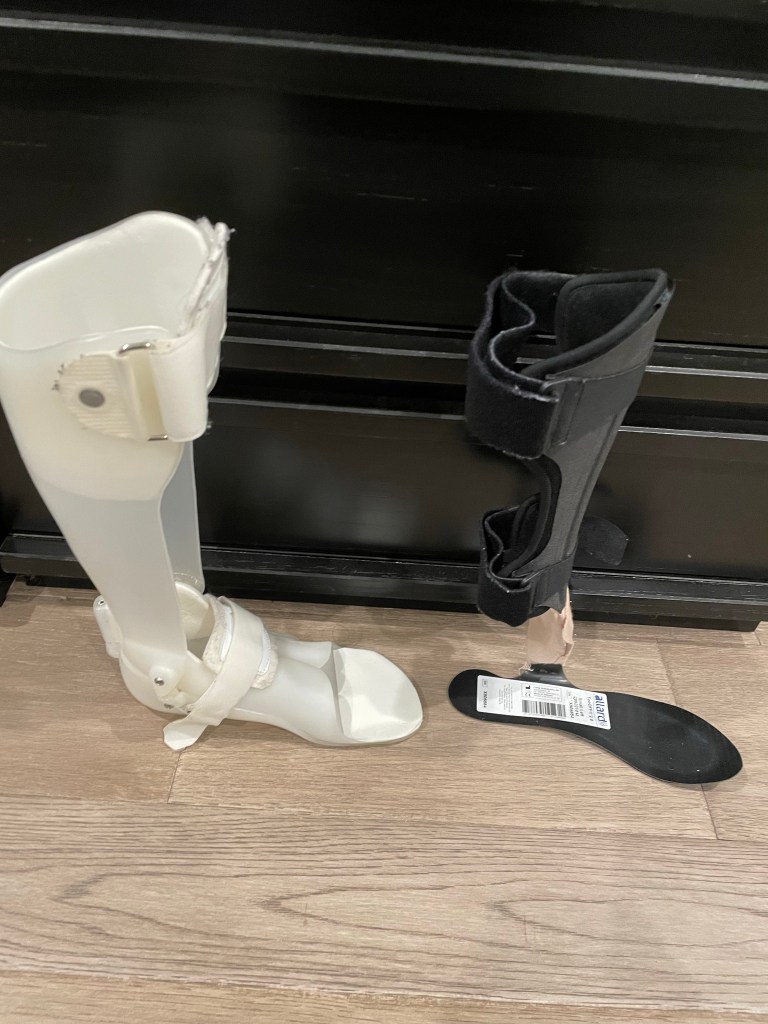
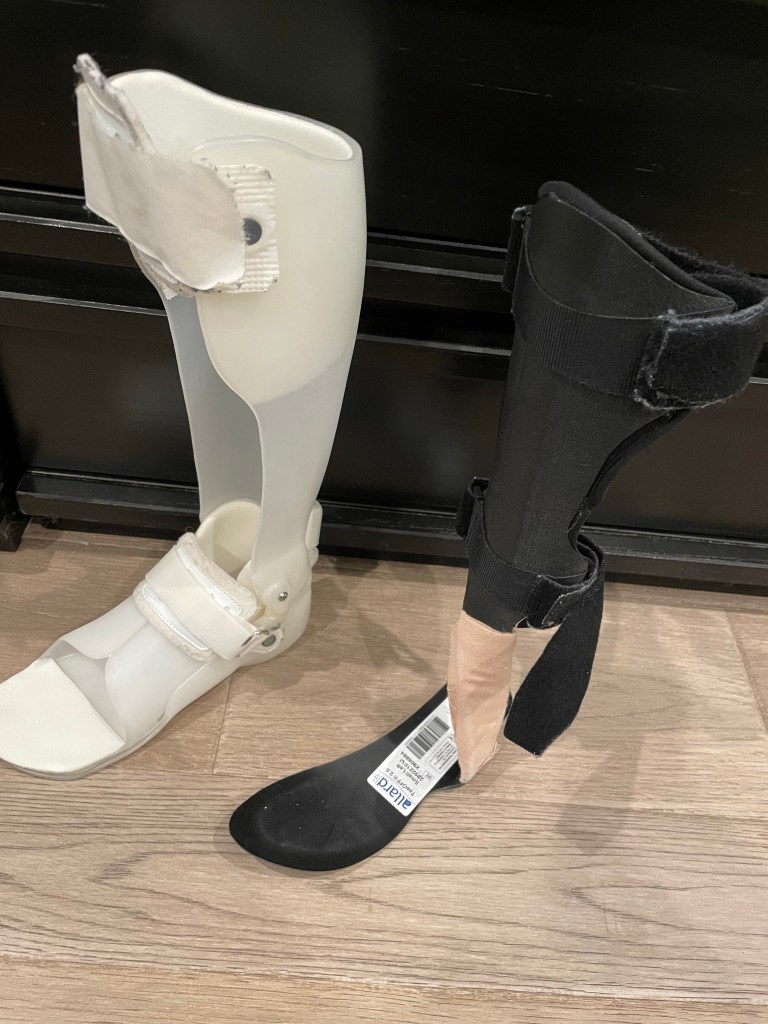
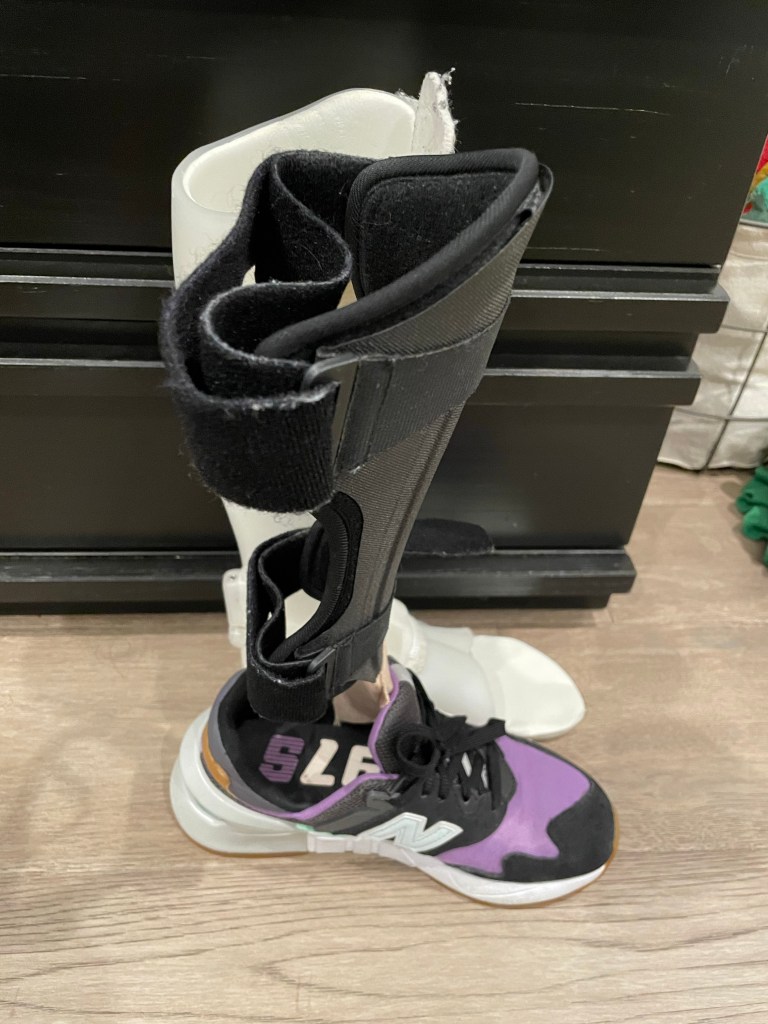
Pic 3: From the side angle you can see how the carbon fiber one slips into my existing shoe size. The custom AFO would not be able to fit into my current shoe
Balancing on a bosu picking up cones. The purpose of this exercise is to put weight on my left leg so I can learn to depend on it again
Bearing weight on my left leg long enough to do leg slides on my right leg. The goal is to be able to eventually stand 5 seconds on my left leg without holding on
These exercises seem to be so elementary but they are so HARD for someone who is RELEARNING BASIC FUNCTIONALITY. I’m not only combating fear but I’m also combating my spasticity (tone). which is something I will explain in depth in a later post but here is a quick description.
Spasticity is a condition in which there is an abnormal increase in muscle tone or stiffness of muscle, which might interfere with movement, speech, or be associated with discomfort or pain. Spasticity is usually caused by damage to nerve pathways within the brain or spinal cord that control muscle movement.
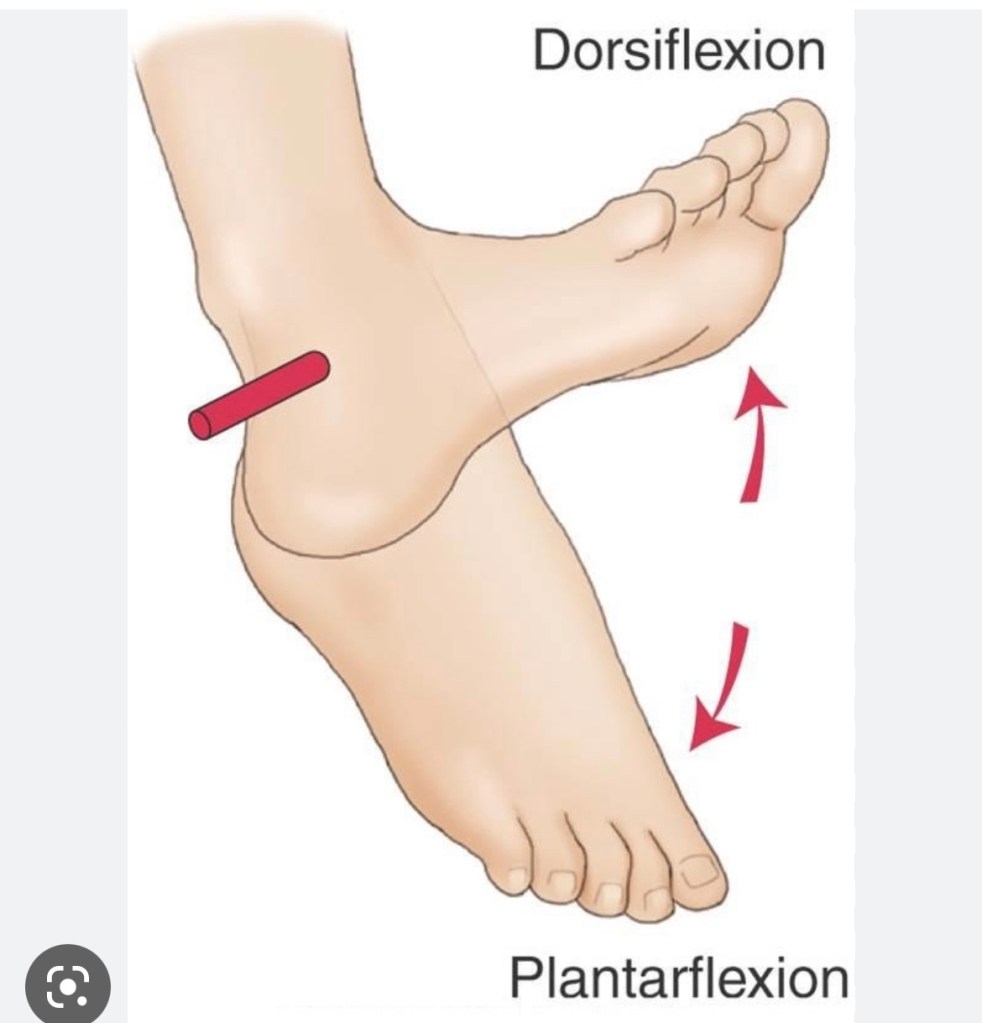
The way it affects me in my left leg is anytime I feel unsteady or unstable, my toes will curl involuntarily and I lose balance. So when I don’t have the comfort of my right leg to support me, my body freaks out and my muscle movement gets impacted (toes curl, ankle could roll) plus I still have drop foot which means I currently don’t have left ankle mobility to point my foot up. If I’m not wearing my AFO, I will trip over my left foot because I don’t have dorsiflexion which is needed to walk.
Standing on my left leg and putting just my right toes on the box for support
I LOVE my physical therapist. She’s always finding new and creative ways to challenge me and my left leg. Her goal is for me to stand on my left leg without holding on for at least 5 seconds.
In addition to these fundamentals I am also relearning how to use my hip, hamstrings, quads and glute muscles.
I wish I had captured videos on these hamstring curls from the beginning. You will have to trust me when I tell you they were ROUGH LOOKING. I could barely get my leg up and when I finally did, I couldn’t control it down. a hamstring curl is basically a bend at the knee. This video shows how I initiate my hip first before bending my knee. My therapist put weights on my hip to hold me down because I’m activating the wrong muscle. As you can see my hips are very strong and I knock the weights over.
Doing a hamstring curl laying on my stomach with weights on my hip to keep me from raising my hip (hip hiking)
Doing a hamstring curl again but instead of weights my therapist is using her leg to keep my hip down
There’s a little improvement between the 3 months. The goal is to use the correct muscles when initiating a hamstring curl which is used in daily walking and running. Currently there’s a bit of hip hiking when I walk and I almost look as though I’m kicking my foot forward. My body had adopted to this way of walking from the moment I had any movement and muscle strength – just not all the muscles and nerve connections come back at the same time so the stronger ones take over first and the body just adapts to what it has. Now that I’m slowly getting my nerve connection and building strength, I’m having to UNLEARN ALL MY BAD HABITS.
Doing a hamstring curl almost correctly. There is little hip hiking and zero weight added to keep my hip down
Although both videos display almost to none hip hiking, I need to point out the gap between raising my left leg is shorten making it a tad bit easier to bend the leg up. These are the modifications made until the appropriate muscles are fully functioning. I told you my PT therapist is awesome!
Learning to stand on left leg and control left knee without hyperextending. On the last one rep, you will notice how I purposely lockout my knee and it buckled making the transition very rigid
We have all taken walking, skipping, galloping, hopping, kicking, running, sprinting for granted. I remember when I used to just skip around in my office building just because I could. Yes, back then 30 year old me used to just skip for fun. I miss those days. Now I’m just trying to learn how to 1) walk 2) walk normally so I’m not causing pain in my joints and hip 3) hopefully one day be able to skip, hop, kick and run again. After all these months, I will still continue to fight for progress and stay tuned for my updates.
 Stephanie Torres
One response to “Learning How to Walk (and it’s not cute like watching Bambi)”
I don’t think many of us could do that balancing one picking up those cones!!
LikeLike